
In today‘s fast-paced tech landscape, selecting the right tools is paramount. When it comes to the top 10 programming frameworks for app development, the sheer volume of options can be overwhelming. React or Vue? Flutter or native? Should you prioritize cross-platform capabilities or framework-specific optimizations?
This decision isn’t just about picking a technology—it’s about shaping your team’s efficiency, your application’s scalability, and ultimately, your project’s success. Whether you’re evaluating mobile development frameworks for a startup MVP or web app frameworks for an enterprise platform, the stakes are high.
In this guide, we’ll navigate the landscape of modern frameworks, focusing on practical insights for both web and mobile development. We’ll explore why cross platform app development has become essential, and how the right tools can accelerate your journey from concept to deployment.
Table of Contents
Navigating the Top 10 Programming Frameworks for App Development in 2025
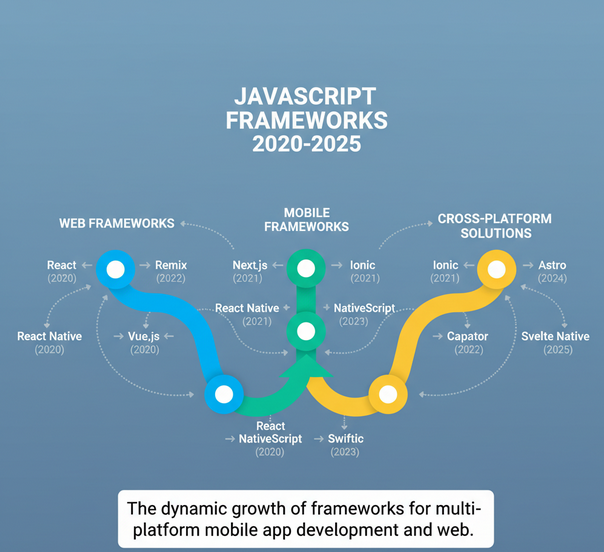
The framework ecosystem has matured dramatically. What once felt like fragmented camps—web versus mobile, native versus hybrid—has evolved into a more interconnected landscape where JavaScript-centric frameworks dominate both domains.
The trend toward cross platform app development isn’t just about cost savings anymore. It’s about strategic agility. Organizations now prioritize frameworks that enable multi platform mobile app development while maintaining code quality and performance. The rise of React Native, Flutter, and progressive web apps has proven that “write once, run anywhere” is no longer a compromise—it’s a competitive advantage.
Our criteria for the top 10 programming frameworks for app development in 2025 include:
- Community strength and ecosystem maturity: Active development, abundant resources, and enterprise adoption
- Performance and scalability: Real-world benchmarks and architectural patterns
- Developer experience: Learning curve, tooling, and debugging capabilities
- Cross-platform potential: Flexibility to target web, mobile, and desktop
- Future-proofing: Backward compatibility and long-term viability
Our Picks: The Top 10 Programming Frameworks for App Development Today
1. React (for Web & Multi Platform Mobile App Development)
React has transcended its origins as a Facebook library to become the backbone of modern web development. Its component-based architecture and virtual DOM have influenced virtually every framework that followed.
Best for: Single-page applications, progressive web apps, and through React Native, truly native mobile applications for iOS and Android.
The React ecosystem is vast—from state management (Redux, Zustand) to server-side rendering (Next.js), you’ll find battle-tested solutions for nearly every challenge. The introduction of hooks simplified state management, while concurrent features promise even better performance.
The key is maintaining component reusability while avoiding prop-drilling hell and state management complexity—challenges that improve with experience and the right architectural patterns.
2. Vue.js (for Web & Cross Platform App Development)
Vue.js strikes a remarkable balance between the flexibility of React and the opinionated structure of Angular. Created by Evan You, Vue has grown from a one-person project to a community-driven framework with enterprise backing.
Best for: Progressive web apps, single-page applications, and when combined with Electron, cross-platform desktop applications.
Vue’s approachable learning curve makes it popular among developers transitioning from jQuery or those new to reactive frameworks. The Composition API (introduced in Vue 3) brings React-like flexibility while maintaining Vue’s signature simplicity, making it an excellent choice for teams of varying skill levels.
3. Angular (for Enterprise Web App Frameworks)
Angular remains the framework of choice for large-scale enterprise applications. Its opinionated structure, TypeScript foundation, and comprehensive tooling make it ideal for teams that value consistency and maintainability.
Best for: Complex enterprise applications, admin dashboards, and projects requiring robust architecture from day one.
The Angular CLI, dependency injection system, and RxJS integration provide a complete solution for ambitious web applications. While the learning curve is steeper than React or Vue, the payoff is a highly maintainable codebase with clear patterns and strong typing that catches errors before they reach production.
4. Next.js (The React Framework for Production)
Next.js has become synonymous with production-ready React applications. Vercel’s framework handles server-side rendering, static site generation, API routes, and edge functions—transforming React from a library into a full-stack solution.
Best for: SEO-critical applications, e-commerce platforms, content-heavy sites, and serverless architectures.
The introduction of the App Router and React Server Components has positioned Next.js at the forefront of modern web architecture. Incremental static regeneration means you can have the best of both static and dynamic worlds, while the built-in image optimization and font loading eliminate common performance pitfalls.
5. Nuxt.js (The Intuitive Vue Framework)
Nuxt.js does for Vue what Next.js does for React—it provides a robust, opinionated framework for building production applications with server-side rendering, static site generation, and hybrid rendering capabilities.
Best for: Content-driven applications, e-commerce platforms, and full-stack Vue applications.
Nuxt 3’s rewrite brought improved performance, better TypeScript support, and a more flexible architecture. The auto-imports feature and file-based routing reduce boilerplate, letting developers focus on building features rather than configuration. The ecosystem includes modules for nearly every integration you might need, from authentication to analytics.
6. Laravel (for Robust Backend & Web App Frameworks)
While primarily known as a PHP backend framework, Laravel’s integration with Livewire and Inertia.js has positioned it as a compelling full-stack option. Laravel excels at rapid application development without sacrificing code quality.
Best for: Full-stack web applications, API backends, admin panels, and SaaS platforms.
Laravel’s eloquent ORM, queue system, and artisan CLI provide a developer experience that rivals Node.js frameworks. The recent introduction of Laravel Reverb (for WebSockets) and continued improvements to Laravel Octane demonstrate the framework’s commitment to modern web standards. When paired with Livewire or Inertia.js, Laravel becomes a complete full-stack solution with excellent developer ergonomics.
7. Flutter (for Mobile Development Frameworks & Cross-Platform UI)
Flutter represents Google’s vision for truly native cross-platform development. Unlike React Native’s bridge architecture, Flutter compiles to native code and uses its own rendering engine, resulting in consistent 60fps performance.
Best for: Cross-platform mobile applications, progressive web apps, and increasingly, desktop applications.
The widget-based architecture and hot reload make Flutter exceptionally productive for UI development. While Dart may feel unfamiliar initially, developers consistently report that Flutter’s comprehensive widget library and excellent documentation flatten the learning curve. The framework’s ability to target iOS, Android, web, and desktop from a single codebase makes it a strong choice for best cross platform app development strategies.
8. Swift/SwiftUI (for Native iOS Mobile Development Frameworks)
For iOS-first or iOS-exclusive applications, Swift with SwiftUI represents Apple’s modern approach to native development. SwiftUI’s declarative syntax feels familiar to React developers while leveraging Swift’s powerful type system.
Best for: iOS, iPadOS, macOS, watchOS, and tvOS native applications.
SwiftUI has matured significantly since its 2019 introduction. The framework now handles complex layouts, animations, and state management with elegance. When platform-specific features, performance optimization, or deep system integration are critical, native development with Swift remains unmatched. The Xcode previews and live canvas make iteration fast and visual.
9. Kotlin/Jetpack Compose (for Native Android Mobile Development Frameworks)
Kotlin with Jetpack Compose is Android’s answer to SwiftUI—a modern, declarative approach to building native Android UIs. Since Google declared Kotlin the preferred language for Android development, the ecosystem has flourished.
Best for: Native Android applications requiring platform-specific features and optimal performance.
Jetpack Compose eliminates the XML layout files of traditional Android development, replacing them with composable functions that feel intuitive to developers familiar with React. The framework’s integration with Android’s architecture components and Material Design 3 makes building polished applications straightforward. Kotlin Multiplatform also offers a path to code sharing with iOS, though it’s still evolving.
10. Alpine.js (for Lightweight Interactivity in Web App Frameworks)
Alpine.js occupies a unique niche—it brings reactive, declarative behavior to your markup without the overhead of a full framework. Think of it as jQuery for the modern age, but reactive.
Best for: Adding interactivity to server-rendered applications, progressive enhancement, and projects where a full SPA framework would be overkill.
Alpine’s tiny footprint (15kb) and familiar syntax make it perfect for traditional web applications that need sprinkles of JavaScript. It pairs beautifully with Laravel, Rails, Django, or any server-side framework. The framework’s simplicity and component-based approach make it ideal for progressive enhancement and rapid prototyping without the complexity overhead.
Beyond a Single Stack: The Challenge of Multi-Framework UI Development
Here’s a challenge that rarely gets discussed in framework comparisons: maintaining consistent UI components across different projects—or even within a single organization using multiple frameworks.
You’ve standardized on Tailwind CSS for styling. Great. But now your team maintains a React component library, a separate Vue component library, and maybe some Alpine.js components for your Laravel admin panel. Each time you update a button style or card design, it’s a three-framework refactoring job.
This is a real pain point for agencies, product companies, or enterprises pursuing best cross platform app development strategies across web and mobile. The same design system needs to live in multiple codebases, and keeping them in sync becomes a maintenance nightmare.
The ideal solution would be a way to define components once—visually, with immediate feedback—and generate clean, production-ready code for whichever framework you need. Not abstracted wrappers or runtime dependencies, but actual framework-native code that looks like something your developers would write.
This concept of framework-agnostic component development is still evolving, but it represents an important shift in how we think about UI development. Whether through design tokens, web components, or visual builders that output framework-specific code, the goal is the same: maintain design consistency without multiplying development effort.
For teams working across various web app frameworks and mobile development frameworks, solving this consistency challenge can transform UI development from a bottleneck into a streamlined process. The key is finding workflows and tools that respect your framework choices while eliminating redundant implementation work.
Choosing Your Path: Key Considerations for App Development Frameworks
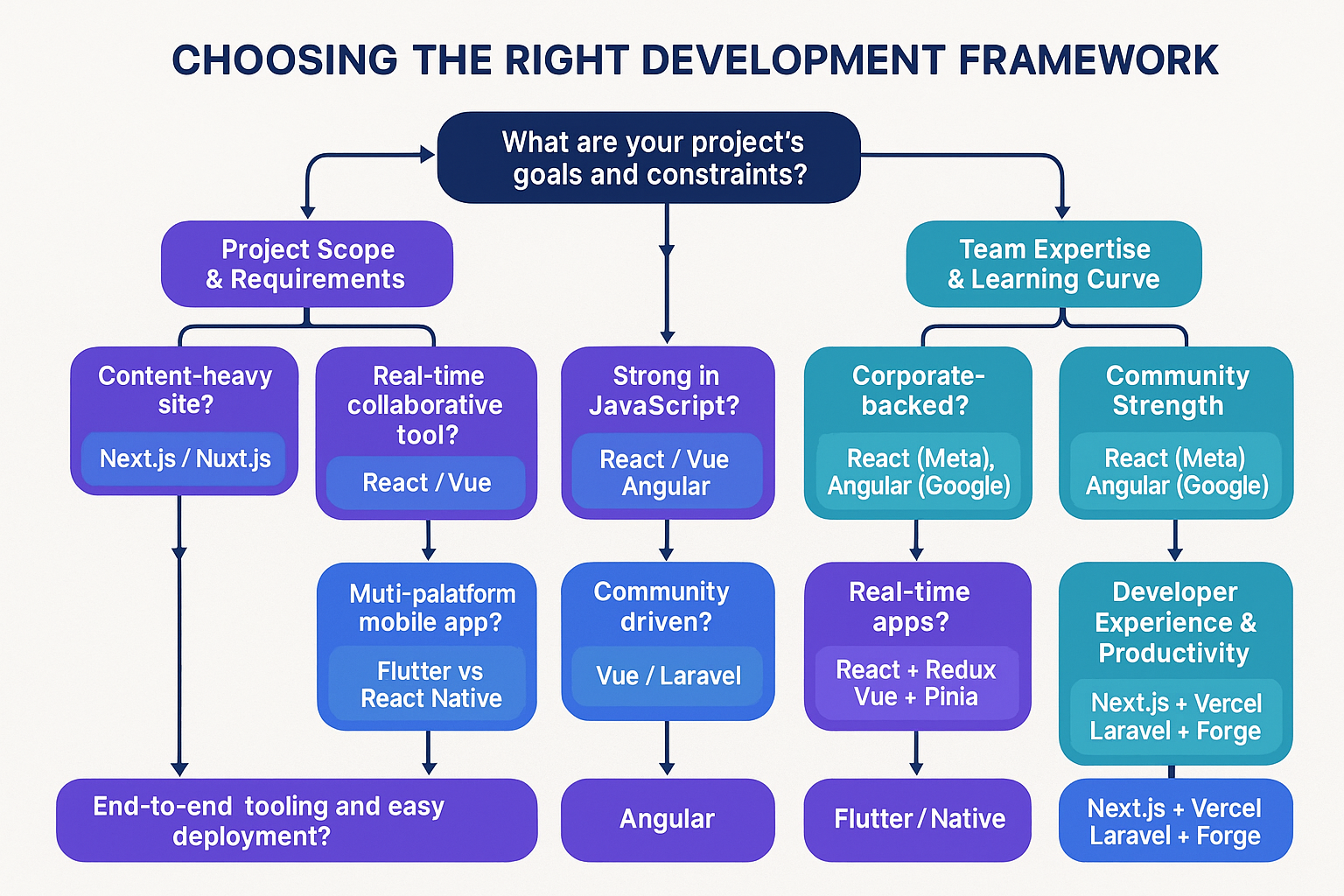
The “best” framework doesn’t exist in a vacuum. It exists at the intersection of your project’s requirements, your team’s expertise, and your organization’s strategic goals. Here’s how to navigate that decision:
Project Scope & Requirements
Building a content-heavy marketing site? Next.js or Nuxt.js with static generation will serve you well. Developing a real-time collaborative tool? React or Vue with WebSocket integration makes sense. Need a native mobile app with complex animations? Flutter or native Swift/Kotlin should be on your shortlist.
For multi platform mobile app development, the choice often comes down to Flutter (for pixel-perfect cross-platform consistency) versus React Native (for leveraging existing JavaScript expertise and native modules).
Team Expertise & Learning Curve
The best framework is the one your team can be productive with. If you have strong JavaScript developers, React, Vue, or Angular are natural choices. A team experienced in PHP? Laravel with Livewire provides a smooth path to modern web development without abandoning your core competency.
Consider the hiring market too. React developers are abundant; Flutter developers less so. This affects both recruitment and the availability of contractors or consultants.
Community & Ecosystem Strength
A vibrant community means more than GitHub stars. It means:
- Abundant learning resources and tutorials
- Third-party packages for common features
- Active forums where you can get help
- Regular updates and security patches
- Clear migration paths between versions
React and Angular have corporate backing (Meta and Google), which provides stability. Vue and Laravel thrive as community-driven projects with strong governance. Evaluate what model aligns with your risk tolerance.
Performance & Scalability
Modern frameworks handle most performance requirements out of the box, but specific use cases demand specific optimizations. Real-time applications benefit from frameworks with excellent state management (React with Redux, Vue with Pinia). Large enterprise applications need frameworks that enforce architecture (Angular). Mobile apps requiring 60fps animations lean toward Flutter or native solutions.
Remember: premature optimization wastes time. Choose a framework that won’t become a bottleneck at scale, but don’t over-engineer for problems you don’t have yet.
Developer Experience & Productivity
This is often undervalued but critically important. A framework with excellent error messages, hot reload, TypeScript support, and comprehensive documentation dramatically reduces development time and debugging frustration.
Consider the full development lifecycle: local development, testing, deployment, monitoring. Frameworks like Next.js with Vercel or Laravel with Forge provide exceptional end-to-end experiences that save countless hours.
The Right Framework, Empowered Development
The landscape of the top 10 programming frameworks for app development reflects the maturity and diversity of modern software development. There’s no universal “best” choice—only the right choice for your specific context.
What’s become clear is that cross platform app development and multi platform mobile app development strategies are no longer compromises. With frameworks like React Native and Flutter, you can build beautiful, performant applications that reach users across every platform. With full-stack frameworks like Next.js, Nuxt.js, and Laravel, you can build complete applications with smaller teams and faster iteration cycles.
The framework you choose will evolve. React introduced hooks and changed how we think about state. Vue 3 brought the Composition API. Angular embraced standalone components. SwiftUI and Jetpack Compose are still maturing. The key is choosing technologies with clear evolution paths and communities committed to thoughtful progress.
As you evaluate web app frameworks and mobile development frameworks, remember that the tools surrounding your core technology—your UI component system, your state management approach, your testing strategy—matter just as much as the framework itself. Invest time in understanding these ecosystems, not just the frameworks themselves.
The most successful projects aren’t built on the “best” framework—they’re built by teams who deeply understand their chosen tools and use them effectively.